Category Archives: MS Treatments

MS COULD SCIENCE HAVE IT ALL WRONG


Spider Web between trees

Natures own Dream Catcher

      When I was in high school, all of those many decades ago, we were taught that each cell in the human body would eventually die off and over a period of seven years every cell in your body would replace itself with a new cell. I assume that is still true even though many things have been changed since that prehistoric time of the early to mid 1970’s.

     Recently I have read in quite a few new studies concerning multiple sclerosis that researchers are starting to believe that after the first major attack or exacerbation the body actually repairs most of the damage to the myelin sheath causing a period of near normal function without any further symptoms. In my case, I experienced a period of almost six years before my next attack, which was far worse then the first attack. And reading this just makes me wonder if perhaps doctors and researchers might not be looking at this from the right perspective?

     What if the immune system is doing exactly what it’s supposed to be doing by cleaning out these myelin cells as they die off but it’s our body’s ability to replace these cells with new ones that is the problem? This would far better explain, in my opinion at least, why almost no two individuals with multiple sclerosis experience the disease in the same way with the same symptoms.

     If this were true it could also explain why some people have a benign form of this disease because there body might retain a larger portion of its ability to regenerate then say people who have a more progressive form of the disease where they may have lost the ability to regenerate new cells at all with in the central nervous system.

     And of course it’s very possible that my little theory here is completely wrong but it does bring me to believing that, “I really don’t care what causes MS”. I would really much rather see science and researchers spend their research dollars on ways to repair the myelin sheathing because I can live with having this disease. I just don’t want to have to live with the symptoms of having this disease!

Does that make sense?

MS AND MS LIKE DISEASES IN DOGS AND CATS


     Mountain woodsA recent MS study suggested that people who grew up with cats during most of their lives appeared to have a less aggressive form of multiple sclerosis then those people who didn’t grow up with cats. However, on the flip side of that, back in the eighties there were researchers who also thought that one possible contributing factor in developing MS may have been a bacteria/virus found in cat feces that people were getting from cleaning their cats liter boxes. In the years, and from several studies done since, that connection has never been proven as being true even though that bacteria is very real and anyone with MS, or otherwise, should take precautions when cleaning cat liter boxes as it would more than likely make your MS symptoms even worse were you to contract that nasty bug as well as being difficult to get rid of.

     And surprisingly enough dogs have their very own disease that is very similar to multiple sclerosis called, Degenerative Myelopathy or DM, as it is often referred to as. And just like MS this disease is considered to be an auto-immune disorder with many of the same symptoms in dogs, as their human MS sufferers experience, but no link has ever been found that even remotely connects these two diseases. And finally, dogs are also prone to a degenerative disc disorder that can mimic some of the symptoms of MS but this can usually be treated with surgery in the more extreme cases.

     Degenerative Myelopathy, again like multiple sclerosis, has no cure and progressively gets worse just like MS. The only treatment for DM that seems to help hold this disorder at bay is taking your dog for long walks and even somewhat extreme workouts with their toys as physical activity appears to slow the progression of DM significantly in many cases. And what is a bit strange about that, is that Neurologists are starting to believe the exact same thing about people suffering from MS, that a sedentary lifestyle may be the worst thing for multiple sclerosis sufferers over the long turn.  

     Do cats and dogs offer any real health benefits to people with MS? It turns out that; “yes!” they offer a whole host of beneficial health enhancing benefits. If you have a dog I am pretty sure that many of you are aware of the need to walk your dog several times a day for potty trips and so dogs can use their social skills by smelling trees, sign posts, street lights and anything else that lies in their usual walking path which also helps lower high blood pressure in the person doing the walking. I recently had a friends dog and got several workouts everyday which I’m sure my Neurologist would have loved to know if I had told him as he is constantly telling me that I am physically able to do more than I currently do. And that dog also liked to play rough, so I was the one who had to adjust to the extra workout, not him.

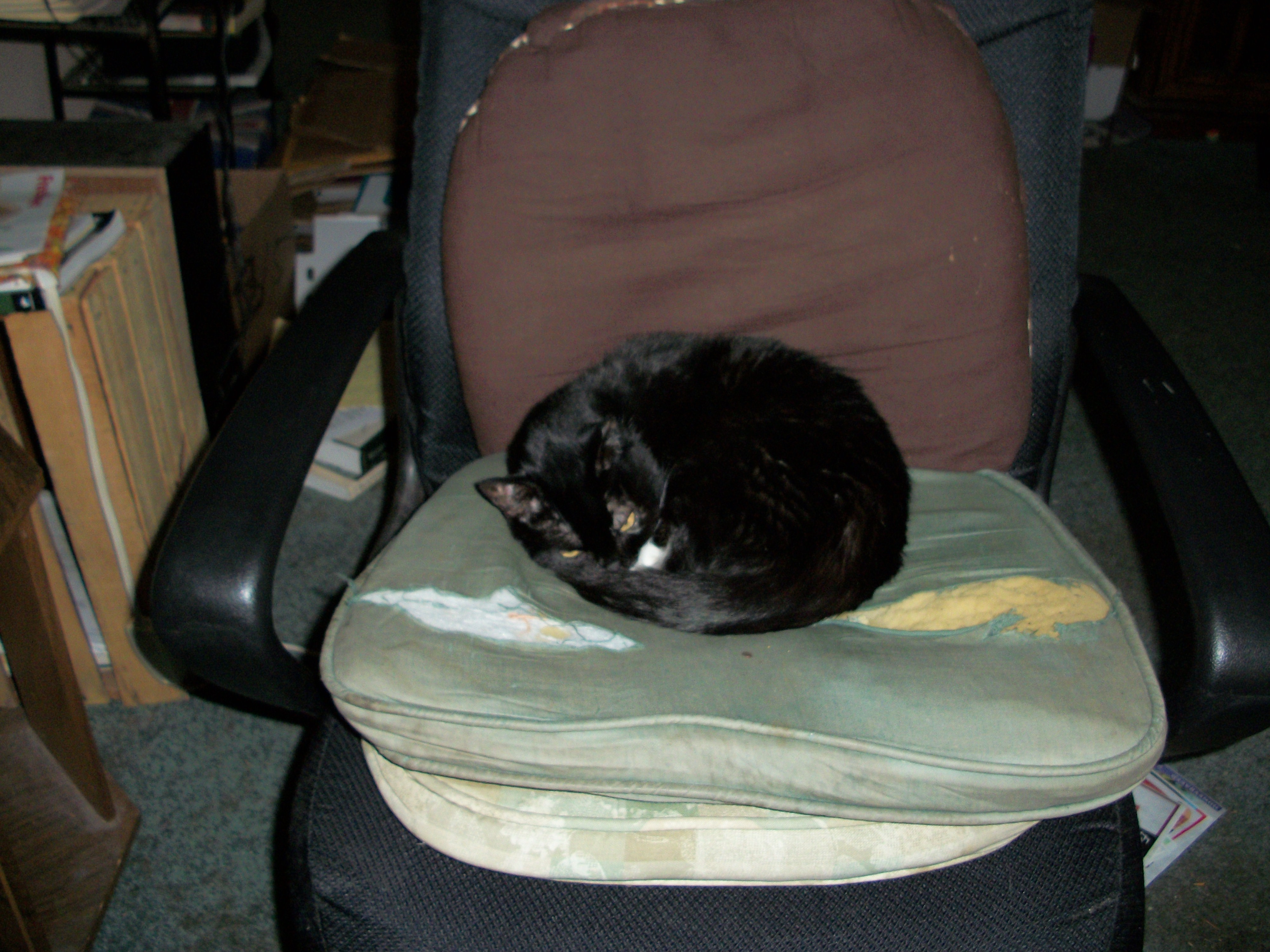
     And yes cats provide their own unique health benefits for their human companions.It has been shown in lab studies that just having a cat around can reduce the stress related chemicals that humans experience throughout any given day. And it’s also been proven that when a cat purrs it actually reduces the blood pressure in any human that is in ear shot of their kitty. And that drop can be as much as twenty points according to some studies and that’s very significant for someone like me who has high blood pressure. And yes, one of my best friend’s, is my eighteen year old cat, Lucky!

Cat on Chair

Lucky!

     In conclusion, if you have MS or any disease that causes you to feel lost and alone I can not stress enough how much having a pet can help you through the hard times. If you can and don’t already have a pet, and if you don’t suffer from allergies, please consider going to your local shelter and see if you can’t hook yourself up with a forever four legged companion. I honestly think that it could be the best treatment you ever got for all of your ills!

*****

I’m requesting stories from any and all of you who have ever had a pet die and than return in any way to let you know that they survived death and came back to ease your fears about their crossing. I think I’m going to write a book about pets surviving death as I have had like at least three of my pets return after death to comfort me after their transition.

What I would like for you to do is to first write the experience you had out in long hand and put it down for a day, or a little while, and then type it out and send it to me at the email address below. If and when I write the book I will certainly let everyone know especially if their story made it into the book. This is kind of a nonscientific study that I am undertaking so I would love to hear from you all if you’ve got a story to tell. The reason for having you write it out twice is that usually after you write something once and wait a little bit your mind starts to recall the experience and you often remember more than you did in your first draft. And I want the stories to be as in-depth as they possibly can be.

Please send your stories to: wc.walker@yahoo.com

Thank you in advance. And please ask around family and friends to see if they have stories to contribute. Please put, Pets surviving Death, in the subject box!


MS INFLAMMATION AND CHOCOLATE

Lindt Chocolate Bars

     Research has already proven that one of the biggest factors in Multiple Sclerosis, as well as many other diseases both autoimmune and otherwise, is that of inflammation. It is becoming apparent that this one indicator of an MS attack is what may be the biggest factor in why people suffer from the debilitating effects of MS, which is why a recent study about chocolates amazing ability to reduce inflammation in both heart attack and stroke victims caught my eye.

     This study was done on older adults, and to be fair here, it had nothing to do with multiple sclerosis but the study did show the amazing ability of flavonoids, which are found in chocolate, to decrease inflammation throughout the entire circulatory system as well as the brain. And since the brain is nothing more then a cluster of neuron tissue, which is what MS attacks, I think it’s only safe to assume that chocolate would also significantly reduce inflammation in the nervous system as well.

     And this study was done with people who were eating about half of a regular cheap store bought candy bar each day made of mostly milk chocolate and not the darker higher content of cocoa chocolate bars that you find in many health food stores. These chocolate bars cost significantly more then what you pay at your local convenience store and have far less sugar in them, but the flavonoid content of them is many times higher then what milk chocolate contains, which is very little.

     If you are unaware of what flavonoids are, you may have heard on the news in the past that drinking either grape juice or red wine is healthful because of the high amount of flavonoids found in them. It’s thought; that maybe the reason why Italians can eat such a high fat and carbohydrate diet without the same incidents of heart disease that we experience in this country is because of the daily glass of wine they consume at lunch and/or dinner. And the flavonoids in chocolate bars with a cocoa content of at least 50% and higher is many times higher then what is found in even a full glass of  red wine.

     Another natural food that is also extremely high in flavonoids are dried cherries which are actually prescribed by dieticians for many ailments to also fight, or counter, inflammation throughout the body. So if you can find a candy bar with 80% cocoa that also has dried cherries mixed in as well then that’s all that much better and they do make them because that’s what I eat but they cost anywhere from $2.50 to $4.00 dollars. However you only need to eat four or five small pieces to get a large dose of the beneficial flavonoid content which means one candy bar can last a week.

     In my opinion this is one of the best things that you can try on your own to see if it may help in reducing some of the effects of multiple sclerosis and the accompanying inflammation. And let’s face it the worst outcome you could experience is that nothing changes accept you have something to look forward to each and every night, either after dinner, or before you go to bed.

     Bone Appetite!  


By Bill Walker  

If you would like to submit your own blog piece for this page please contact me at: msandbeyond@gmail.com

 And Don’t forget to look for my new book VISUS available on Amazon.com!

MS-It’s My Life-Not Yours!


Copaxonehenge

Copaxonehenge

       I had been planning my stand against MS for several months as I drove to my neurology appointment a few days ago. I had already determined that the days of injections, after seven plus years, were over. There was no way whatsoever that my doctor was going to convince me of the need to continue the painful practice of daily shots. And, almost on cue, my insurance carrier sealed the deal when they refused to allow me to go to three injections a week instead of the daily injection. But what happened next at my neurology appointment both stunned and elated me.

     I had no more then started my well rehearsed refusal to take any more shots when my doctor calmly stated, “that’s fine, no more injections.”

     And then we began the discussion of my most recent MRI scans and how they compared to the ones I had done five years ago. He told me that there were absolutely no new areas of demyelination anywhere in either the brain or spinal column. And he went on to say that not only had there been no new areas but it appeared that pretty much all of my previous lesions had shrunk and actually appeared to be filling in with what is most likely scar tissue. Which of course isn’t great, but it’s a heck of a lot better then new lesions.

   He went on to say that it would probably benefit me to take some kind of disease modifying drug but that taking a three month long break would probably not have any major effect on the course of my disease since I’m only a year or so away from being sixty. In his opinion my MS is more then likely beginning to burn out at my age and could, though probably not, go back into a state of remission where new myelination may occur.

     And even an outside chance of that happening is better then being able to eat all the chocolate chip cookie dough ice cream that I could have ever dreamed of having. That was a good day indeed!


Bill Walker

         visus228x228

Journey alongside of VISUS to the ocean that holds all oceans in this Orca’s adventure of self-discovery.

http://www.amazon.com/Visus-William-C-Walker-ebook/dp/B00U8ZN4GE/ref=sr_1_1?s=books&ie=UTF8&qid=1425587154&sr=1-1&keywords=Visus

Imagine: A Drug Free MS

Copaxone

     My very first multiple sclerosis attack, which by the way my doctor at the time assured me was just a pinched nerve, lasted around three months. And my symptoms were extremely mild although they did pretty much affect every part of my body. And then, at the end of those three months, that was it I didn’t have any other attacks or symptoms for the next six plus years.

     Fast forward twenty two years and I’m reading how in many cases, after that very first MS event, researchers now believe that the body essentially still retains its ability to repair that initial damage that is done to the myelin. And at least in my case this certainly seems to fit my own disease’s early progression. However, as time goes on your body slowly starts to lose its ability to continue these repairs and the damage becomes much more serious to the central nervous system. Which also seems to fit me, unfortunately, pretty well.

     If that is all true, and only more research will answer that, it seems to me that science should eventually be able to turn the bodies own ability to make these repairs back on. And that is all very encouraging but it was something that I read a few minutes later in my own research that really caught my attention.

     Many researchers are stating that it appears that most of the damage caused by multiple sclerosis takes place up until the age of sixty. And after this, MRI’s are showing little further deterioration in the brain and spinal tissue. And their also starting to question whether or not it’s even prudent to continue use of any of the current disease modifying drugs as they may no longer be having any effect on MS progression.

     Well, I’m not sure about anyone else, but I sure am tired of giving myself daily or every other day injections. I plan to watch the studies very closely over the next couple of years, which will make me sixty, to see if this continues to look like a reality. And if it does, I plan to have a very long discussion with my neurologist.

     I’m rapidly coming to the conclusion that it may be time for me, and perhaps others, to start to consider weaning themselves off of these very expensive treatments which in turn would start to squeeze these drug companies’ profits to the point where they may start to actually look for a cure instead, or, probably not!

by Bill Walker

I just recently published my very first novel, if interested here is the link:

http://www.amazon.com/Visus-William-C-Walker-ebook/dp/B00U8ZN4GE/ref=sr_1_1?s=books&ie=UTF8&qid=1426799056&sr=1-1&keywords=Visus

MS and My Experience in a Clinical Trial

Bill Walker

Bill Walker

Literally just months before I was stricken with my first major MS attack I quit my job to search for another position which meant giving up my health insurance and everything else in hopes of bettering my life. And as you probably have already figured out, this was not one of my best ideas and I paid for that mistake mightily. Let’s fast forward a year and a half roughly from that point to my diagnosis of a major disease with no insurance and no money to speak of to try and treat my illness. It became pretty apparent pretty quickly that without insurance I was going to have to be creative when trying to deal with the crushing news that I had Multiple Sclerosis and no way to financially deal with it. And then someone, I don’t remember who, asked if I had considered signing up for a Clinical Trial?

     When I first started checking out what and where I could go I was apprehensive about whether or not you needed to be insured before they would consider you, and when I found out that you didn’t need any insurance I was ready to do whatever it took to get signed up as it finally felt like something was going right in my life. A few phone calls was all it took to bring me to Virginia Mason Hospital in Seattle Washington and to Doctor Mariko Kita head of staff in the Neurology’s clinical trial’s department. It just so happened that they had two new studies that were just getting underway and in both cases the patient, me, was assured of getting a real drug and not a placebo as can often happen in one of these studies where a control group is always used to determine the efficacy of the drug, or drugs, that are being studied. After considering them both I choose the one that sounded a little bit safer and began the long question and answer process that you have to go though before even being seriously considered. And on the very next visit I was accepted into the study I wanted to participate in and shuttled off to my intake physical which is a real physical where you are probed prodded and lab tested for anything that could negatively influence the outcome of the study before finally being sent to EKG for a heart monitor test. I passed everything with flying stars and told when to return to start my study medication.

     In the study that I choose to participate in there were three groups the first one was the control group that received 20mg Copaxone and since this group was receiving a pre-filled daily dose there was no way they could use this group as a blind study group where the Doctors who were doing the study wouldn’t be able to tell the difference in results with the drug being studied which is often the case. The other two groups consisted of one that would receive the regular dose of 0.25mg Betaseron, now I think they have changed that to 0.30mg, every other day and the third group would get the increased Betasron dose of 0.50mg every other day. The study was a two year blind study between the two Beatseron groups to determine if the larger dose was more effective then the regular dosage. After the two years was finished I received the study results and found out that I had been in the regular 0.25mg dose of Betaseron group. And in the studies final conclusions it was determined that there was no statistical difference between the regular dose of Betaseron and the larger dose of Betaseron.

     My own personal conclusions were a bit different though once you consider that I had received thousands of dollars worth of medication and, for the most part, free health care for two years, my conclusion was a resoundingly positive winning scenario where I was happy to have played my part for science.

     However there are many things to consider before deciding to become a part of a Clinical trial. First of all many of these studies are done at University Hospitals which are almost always located in the heart of the biggest cities in the country which means, or at least in my case it did, an hour and a half drive several times a week in the beginning of the study and at least once every couple of months towards the end. And these studies are run on a very tight schedule so getting caught in traffic adds quite a bit of stress when you’re trying to make an appointment while also trying not to go postal on many of the idiots who seem to think that if they can just get ahead of you, it will be clear sailing to where ever they need to be.

     And when you finally get to the hospital there is another set of problems as many of these hospitals are mini-cities just in themselves, with the Neurology Department on the twentieth floor of one building, your blood draw at the Lab in a completely different building, and the MRI machine located in the basement of a third building a block away, and on some visits you may have to go to all three buildings before you’re done. And for the most part it’s really up to you to get to these separate locations on your own or with family help if at all possible.

     And the paperwork, oh yes, the paperwork, at the beginning of every study be prepared to receive a large notebook sized study manual that will outline the entire study from medication to exams and whatever you and everyone else including Doctors, Nurses, and Clinicians, are expected to perform. And because, this is really a contract, you are expected to read each and every page before you sign each and every page. And when that’s all done they close the deal with the scariest page of all which is the one that states that you understand that though every precaution has been taken to insure your safety there is always the possibility that something might go wrong and that by signing this document you are pretty much giving up all of your legal rights throughout the study and beyond. In essence, this page states that you’re consenting to be a lab rat with very few legal rights, but you’re also accepting the possibility that this study medication may also turn out to be the ultimate cure.

     With all of that in mind, would I ever consider being in another Clinical Trial in the future? The answer for me would be a resounding, “Yes”! I can’t think of a better way to help my fellow MS’ers then to put myself into this position to help find a cure to this monster of a disease. And if I could find one where the research included the study of stem cell injection with the possibility of repairing the damage to the myelin sheathing around my nerves I would be all in as this, in my opinion, seems to be the best path to finding a meaningful treatment or even an eventual cure for this debilitating disease. And if that ever happens, you all will be the first to know!


Bill Walker

MS Michael Jackson & Propofol as a Treatment

100_0470

Wall Mural in Blaine Washington


      If Propofol sounds vaguely familiar to you it’s because it is the same drug that Michael Jackson overdosed on while using it as a sleeping aid. But it’s also the best damn MS treatment I’ve ever received since my diagnosis sixteen years ago bar none. If you’re not familiar with Propofol it’s a fairly new anesthesia medication that is administered via intravenous infusion just before surgery. And if used correctly it is a much safer drug that also has far fewer side effects, then many other drugs such as Ether or Sodium Pentathol that were used previously for the same purpose. In my case it was used for both a Colonoscopy many years ago and more recently for a Hernia operation.

     In both cases where Propofol was used I can not stress enough at how much difference it made in almost all of my MS symptoms. The first thing I noticed upon waking up even though I had discomfort caused by each procedure was a total lack of pain in my lower back as well as no pain in either of my Sciatic Nerves running down my right and left leg’s. The second was a noticeable decrease in the amount of numbness in both my hands and feet. And the third was very little spasticity in my legs after each of these procedures. And this reduction of pain, numbness, and spasticity lasted more than twenty four hours after my discharge from the hospital.

     Of course I have no idea how Propofol works or in fact what it really does to block your awareness while undergoing surgery but I would love having something like it as a sleep aid at night in a pill form specifically to treat Multiple Sclerosis and all of its other symptoms. I don’t know if Propofol is an anti inflammatory or not but it sure seemed much better at blocking my pain and numbness then anything else I’ve ever tried.

    The benefits as far as I’m concerned were so impressive that I would certainly encourage researchers doing MS studies to spend some time looking into Propofol and any other drugs that work in the same manner as possible future treatments. Yes, it was that good at reducing my discomfort, period. It was as close to feeling like I didn’t have MS as I have felt since before my first major attack!


By Bill Walker